The Spreadsheet That Looked Like a Christmas Tree
I was working with a research group recently, and they showed me their screening process. It was entirely set up in Excel.
I was working with a research group recently, and they showed me their screening process. It was entirely set up in Excel.
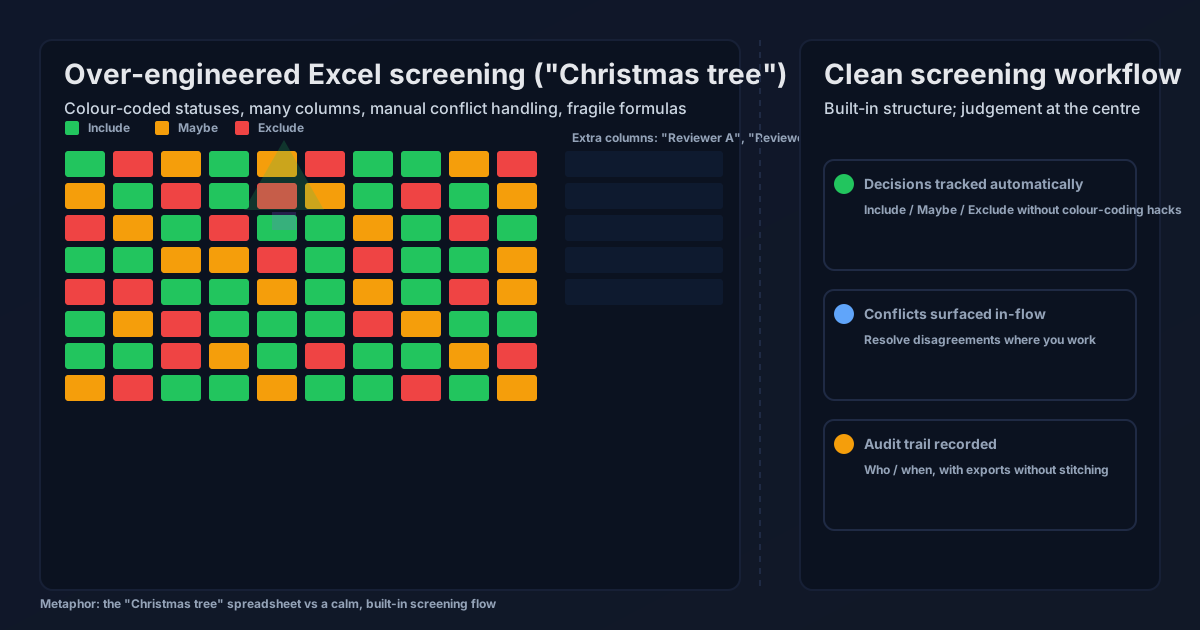
Every inclusion and exclusion decision was entered manually. Conflicts between reviewers were tracked in separate columns. Cells were colour-coded to show status and progress. Comments were layered across multiple tabs. The spreadsheet was not messy in the sense of being careless. It was detailed and carefully constructed. You could see the time that had gone into it.
But visually, it looked like a Christmas tree. They told me it had taken them months to build and refine.
They had engineered a functioning system out of a general-purpose tool. What struck me was how much time and mental energy had gone into building a workaround rather than using something designed specifically for screening. In that moment, I thought very clearly: this is exactly the kind of chaos I am trying to remove.
When the Tool Becomes the Job
In research, we get used to making things work. If a dedicated system is not available, we create our own structure. We build templates, duplicate tabs, add more colour-coding, write instructions in hidden cells, and simulate processes manually that should ideally be built into the environment.
In that spreadsheet, they weren’t just screening papers. They were quietly rebuilding the whole screening process inside Excel. Every decision had to be tracked by hand. When reviewers disagreed, they created extra columns to manage it. When they needed a record of what happened and why, they built that manually too. Even the outputs that would eventually feed into a PRISMA diagram were being stitched together step by step.
It worked. But it meant they were spending as much energy maintaining the structure as they were applying judgement. It was clever and resourceful, but also exhausting.
When you have to build and maintain the structure yourself, your attention shifts. Instead of focusing fully on judgement, on whether a study genuinely meets your criteria, part of your mind is monitoring the spreadsheet. You are thinking about whether the formula will break, someone might overwrite a cell, or the filtering still works correctly.
The tool quietly becomes part of the cognitive burden. Over time, that changes how the work feels.
Engineering Around Limitations
This group was not disorganised. They cared deeply about rigour, and wanted transparency and traceability. The complexity of their spreadsheet was a sign that they were compensating for limitations in the tool they were using.
They were engineering around those limitations instead of working within a system designed for screening. That distinction matters.
When the structure itself is fragile or improvised, you become cautious and constantly hesitate before making changes. You worry about accidentally damaging something that took months to construct. There is more tension than there needs to be.
I have seen this repeatedly. Researchers spending weeks trying to figure out workflows, managing references manually, formatting results for export, stitching outputs together. This is all because the process is not properly supported.
Even if everything looks under control, reality shows a significant portion of their energy is going into maintaining the system rather than applying judgement.
What Changes When the Structure Is Built In
When I showed them dedicated screening software, the difference was clear. There was no big reaction, they simply took a moment to look at it.
The structure was already built in. Decisions were tracked automatically. Disagreements between reviewers were surfaced within the workflow. Audit trails were recorded as part of the process. Exports could be generated without manually assembling them. The underlying logic did not need to be recreated in columns and formulas.
What changed was the tone of the conversation. We stopped talking about how to manage the spreadsheet and started talking about the studies again. The focus shifted back to interpretation, to criteria, to whether a paper genuinely met the threshold.
That is the part that matters to me.
When operational friction is reduced, judgement moves back to the centre of the work. Researchers can concentrate on nuance and evidence rather than maintaining structure. The most demanding part of a systematic review should be the thinking itself, rather than the infrastructure around it.
Why I Built Study-Screener
Experiences like that are exactly why I built Study-Screener.
Excel is not a bad tool. It is powerful and flexible. However, it is not designed to handle screening logic, conflict workflows, or audit-ready audit trails in a structured way. When you force it into that role, you inevitably end up maintaining a workaround.
I did not want researchers spending their best mental energy on spreadsheet design. I wanted the structure to fade into the background so that judgement could lead.
There is a common assumption that automation is primarily about speed. In some cases it is. But what I have learned is that the deeper impact is psychological. When the process is stable and transparent, people relax slightly because they can trust the flow. They are less anxious about breaking something. Their decisions become calmer and more deliberate.
It does not remove the intellectual challenge, but removes the unnecessary strain around it instead.
Where Rigour Should Actually Live
When I look back at that Christmas-tree spreadsheet, it was not incompetence that I saw. I witnessed commitment from researchers trying to protect rigour with the tools available to them.
But I also saw wasted effort.
The goal is to make the process clear enough that you can think properly. It is to remove the operational friction that distracts from judgement.
When that friction is gone, the discussions are more focused and everyone’s headspace is clearer. For me, that moment was a reminder of why I am building what I am building. The reason: to remove the chaos around the process, so that their judgement can do what it was meant to do.
