Systematic Review & Research Insights
Expert insights on systematic reviews, meta-analysis, and AI-powered literature screening.
Editorial scope: reproducible screening workflows, honest notes on AI-assisted triage, and tool comparisons grounded in product behavior.
Start here
- First project setup, keyboard shortcuts, PRISMA exports: Paper screening tool: beginner’s step-by-step guide
- RIS upload and screening mechanics: Complete guide to RIS file screening
- Import from Zotero, EndNote, or a RIS file: How to import from Zotero, EndNote, or a RIS file
- Clear inclusion criteria before you screen thousands of rows: Why “just read the abstracts” fails
- AI triage vs dual manual screening (with literature): AI screening vs manual systematic review
- Moving from Rayyan or comparing tools honestly: Study Screener vs Rayyan
Methods notes anchor to PRISMA 2020 and the Cochrane Handbook, Chapter 4.
13 articles available
Featured Articles
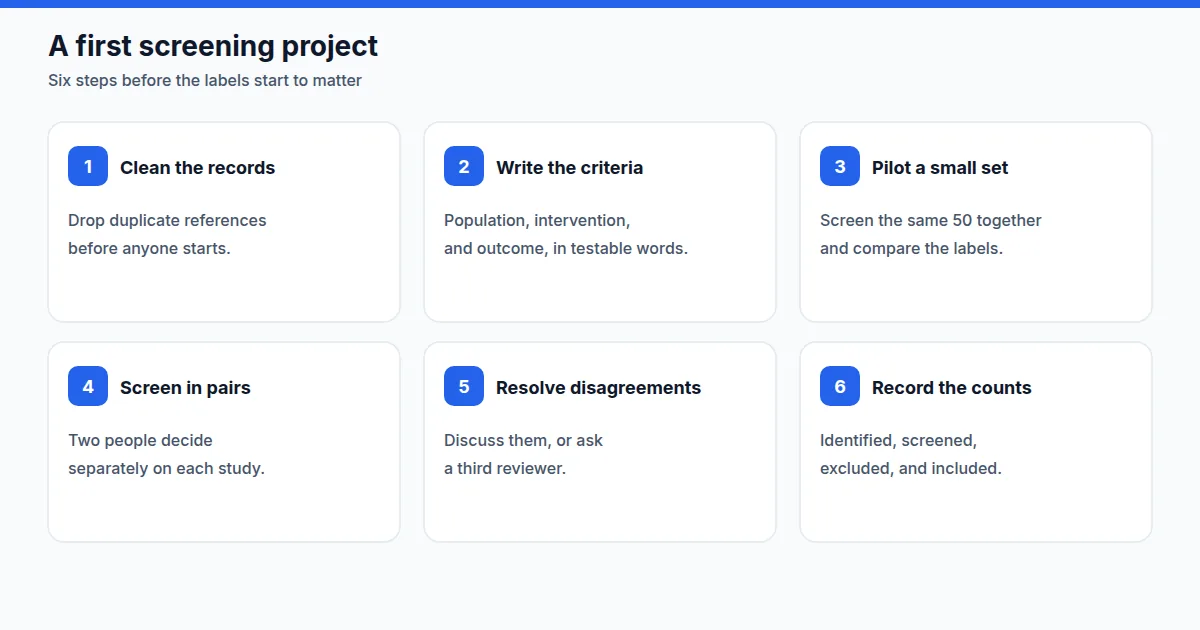
Paper screening tool for systematic review: a beginner’s step-by-step guide
Beginner-friendly guide to paper screening for systematic reviews: essential features, a first workflow, and Study-Screener vs Rayyan vs Covidence with PRISMA 2020 in mind.
Starting your first systematic review can make screening feel daunting. You may have thousands of records and a deadline. A paper screening tool turns that pile...
Read more →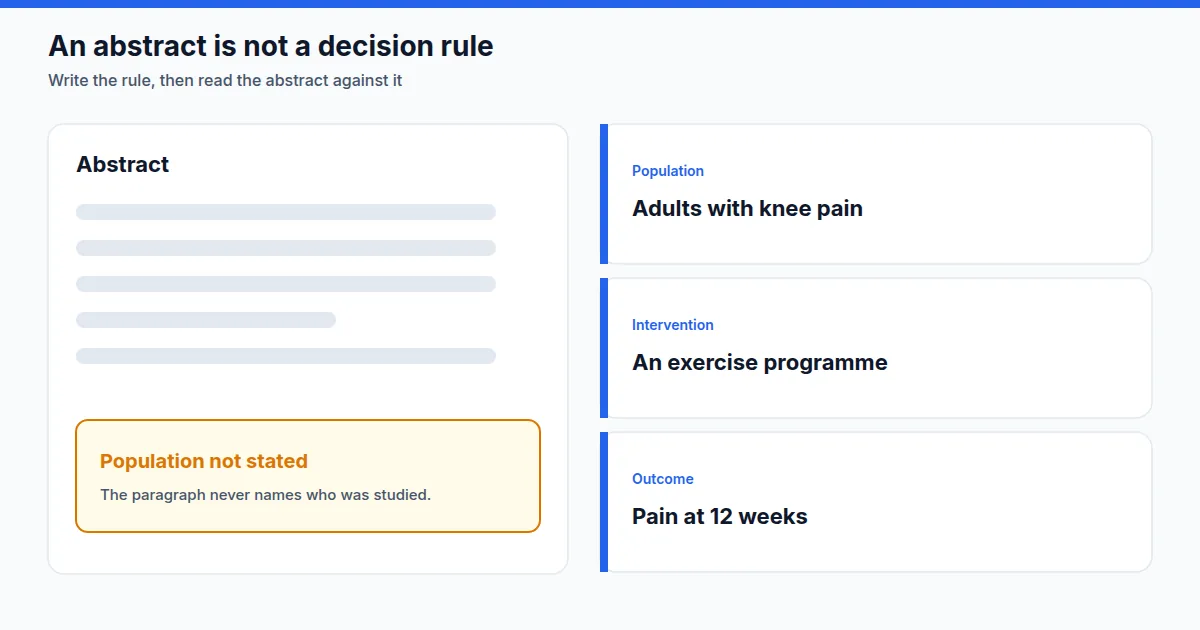
Why 'Just Read the Abstracts' Is the Biggest Misconception in Evidence Screening
The myth that screening abstracts is simple leads to weeks of frustration. Learn why clear criteria and structured workflows are essential for effective evidence screening.
TL;DR: Screening abstracts isn't a simple yes/no process—it's complex decision-making that requires clear, testable criteria and structured workflows. Poor crit...
Read more →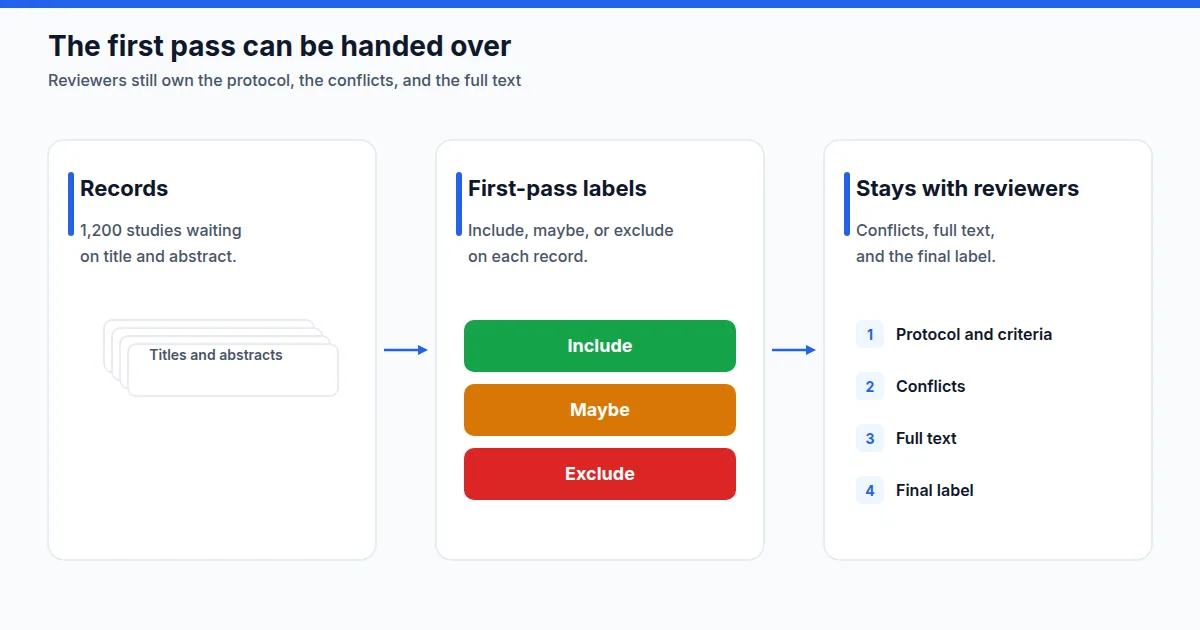
The One Research Task I'd Hand Over to AI Tomorrow
Discover why systematic review screening is the perfect task for AI automation, exploring how AI can revolutionize literature screening while preserving human expertise and quality.
TL;DR: Screening is the most time-consuming bottleneck in systematic reviews, and AI is perfectly suited to handle this repetitive, criteria-based task. By auto...
Read more →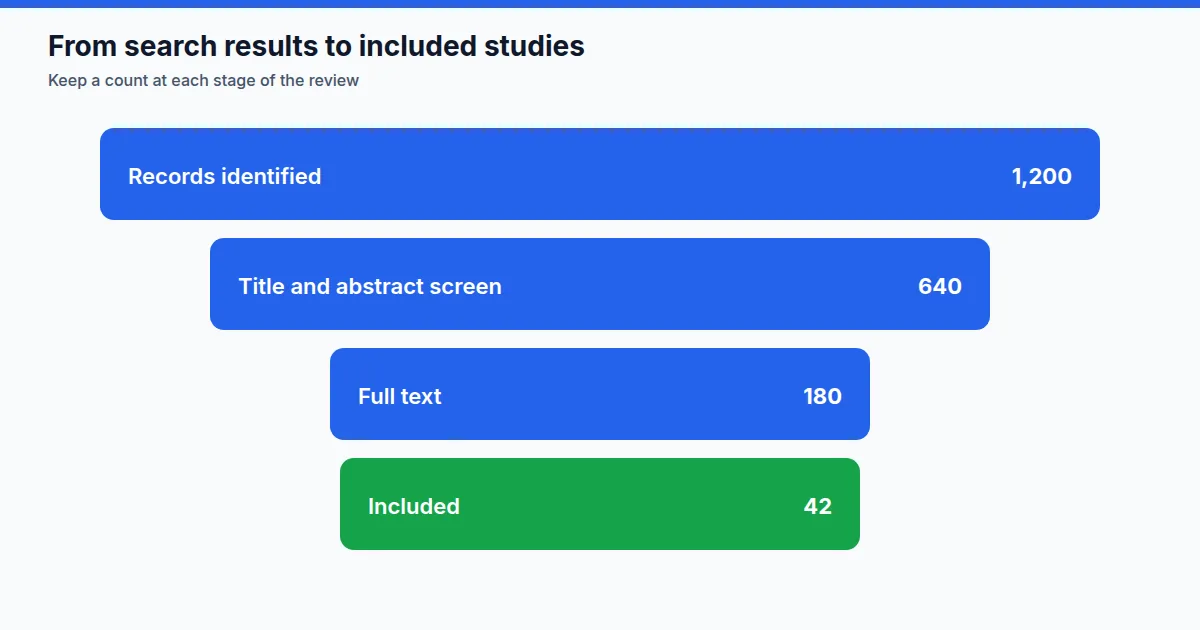
Getting Started with Systematic Reviews: A Complete Beginner's Guide
Learn the fundamentals of conducting systematic reviews from protocol development to final reporting. Perfect for researchers new to evidence synthesis.
Getting Started with Systematic Reviews: A Complete Beginner's Guide Systematic reviews are the cornerstone of evidence-based practice, providing the highest le...
Read more →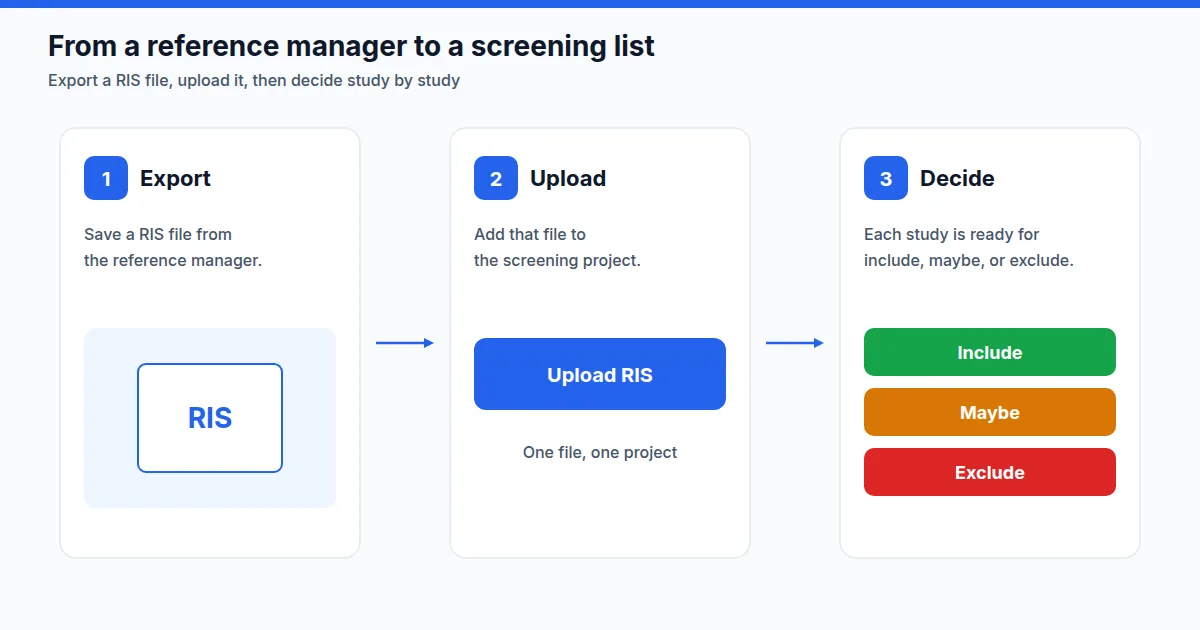
The Complete Guide to RIS File Screening for Systematic Reviews
Screen a RIS file in Study Screener: which records the importer drops, how DOI duplicates collapse, and which counts to copy into a PRISMA diagram.
Screen a RIS file for a systematic review by exporting each database as RIS or PubMed MEDLINE text, uploading those files to Study Screener, and marking each ke...
Read more →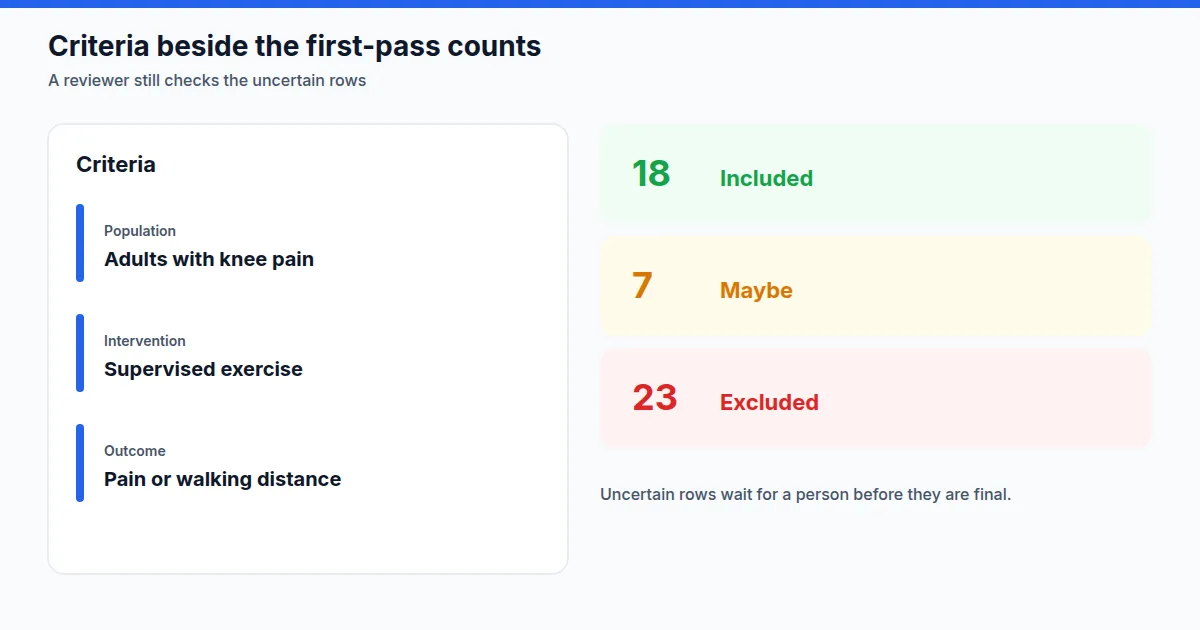
AI-assisted vs manual systematic review screening: evidence, workflows, and limits
Compare manual dual screening with AI-assisted triage using PRISMA 2020 and Cochrane study-selection guidance, plus honest notes on how Study Screener implements each path.
Scope. This article compares title and abstract screening—not full-text PDF review, data extraction, or risk-of-bias assessment. Timing examples below are illus...
Read more →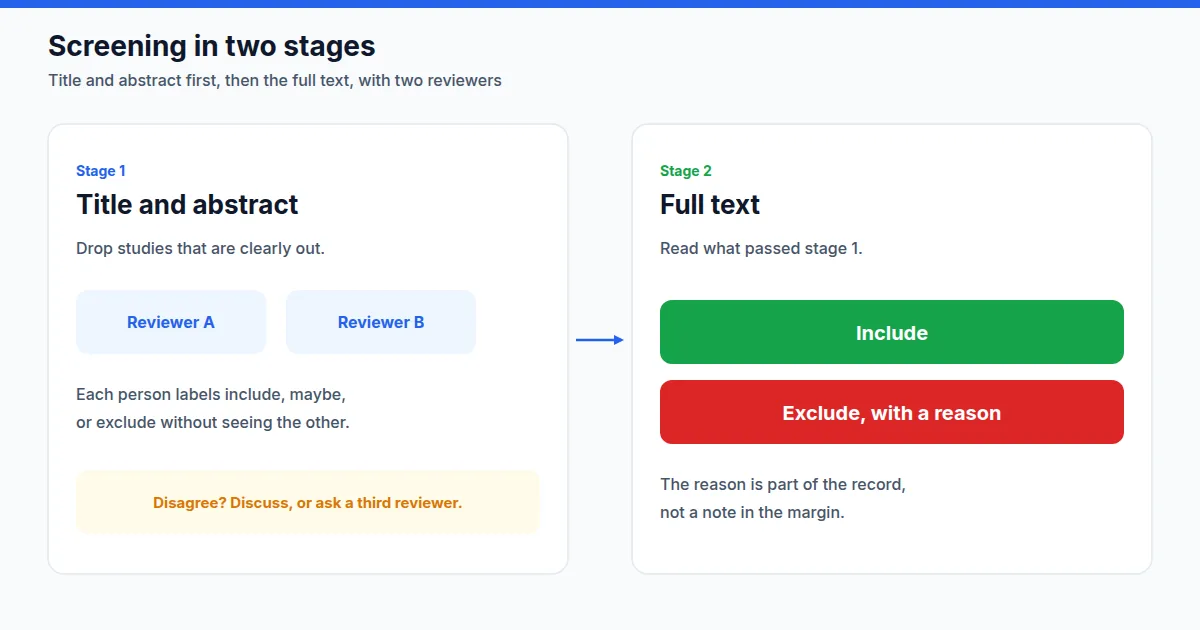
Literature screening in a systematic literature review
Literature screening in a systematic literature review: two-stage, protocol-bound selection (title/abstract, then full text) with dual independent decisions and conflict resolution (PRISMA 2020).
What Is Screening in a Systematic Literature Review? Literature screening is the protocol-bound study selection step in a systematic literature review. Reviewer...
Read more →Latest Articles
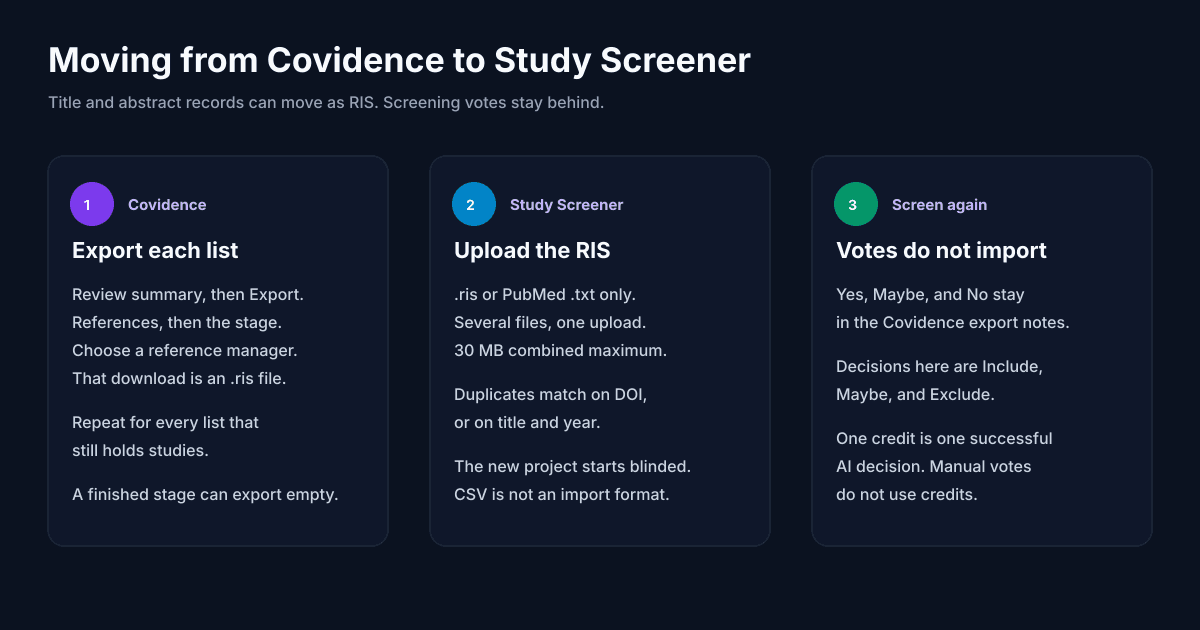
Moving from Covidence to Study Screener
Export each Covidence list as RIS, import it into Study Screener, and see what transfers. Votes do not. Full text and extraction stay in Covidence.
Purpose. This is a migration guide for people who already have a Covidence review and want title and abstract screening in Study Screener. Covidence steps below...
Read more →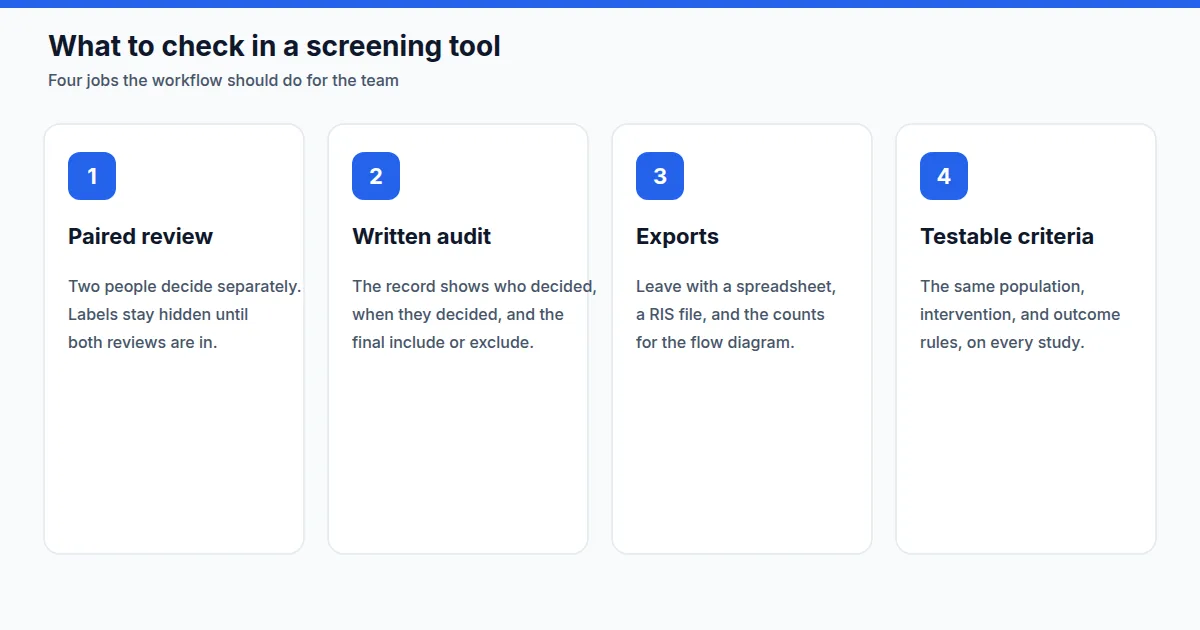
Best screening tools for a systematic review
An honest list of title and abstract screening tools for systematic reviews, with what each one is best for and where it is a poor fit. Vendor claims verified Oct 2026.
Screening tools for a systematic review do the same narrow job in different shapes: they take a pile of titles and abstracts and help two people decide what sta...
Read more →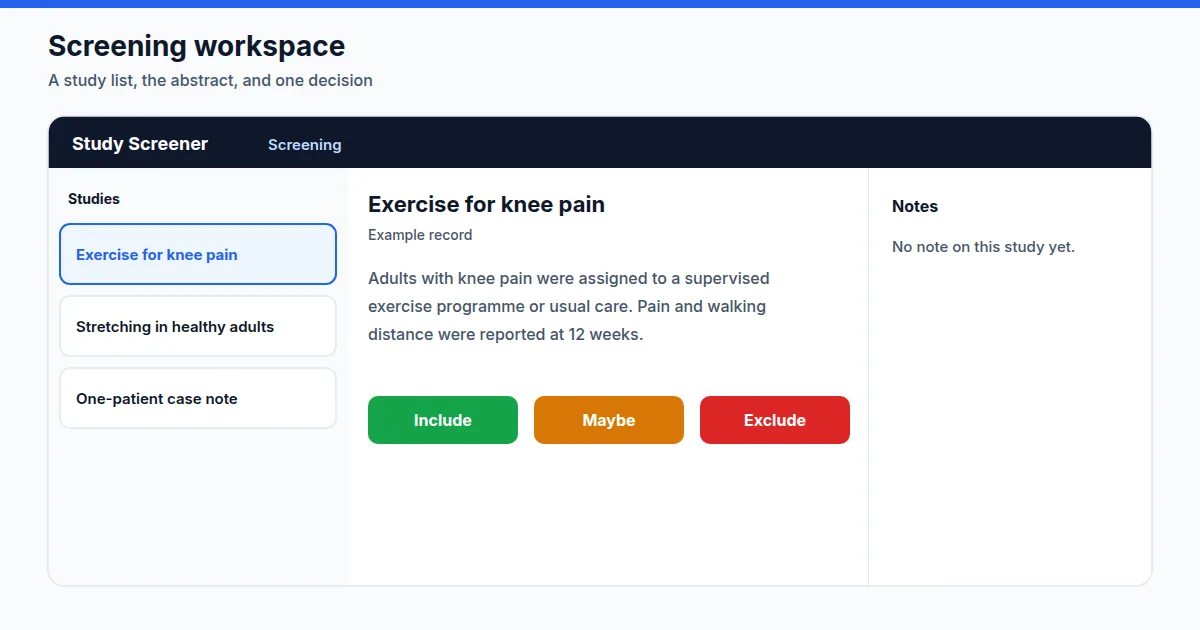
How to import from Zotero, EndNote, or a RIS file
Import a Zotero collection with an API key, or upload a RIS file exported from EndNote, Mendeley, or Zotero into Study Screener.
Study Screener screens titles and abstracts. It does not replace Zotero, EndNote, or Mendeley. You bring references in once, screen them, then export RIS or CSV...
Read more →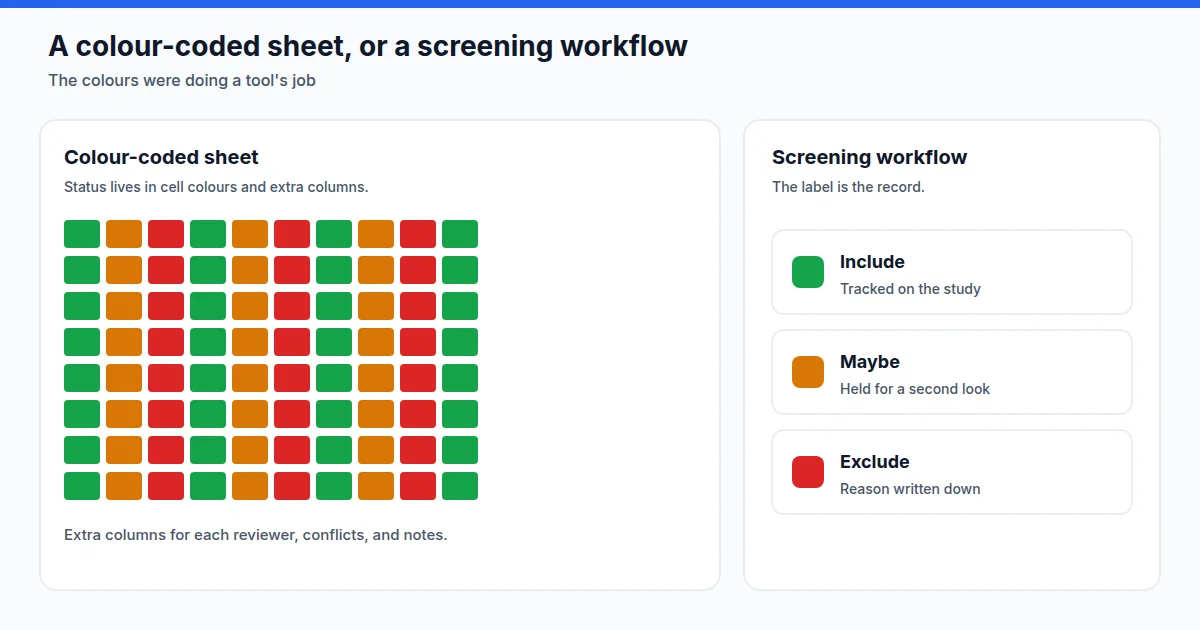
The Spreadsheet That Looked Like a Christmas Tree
I was working with a research group recently, and they showed me their screening process. It was entirely set up in Excel.
I was working with a research group recently, and they showed me their screening process. It was entirely set up in Excel. Every inclusion and exclusion decisio...
Read more →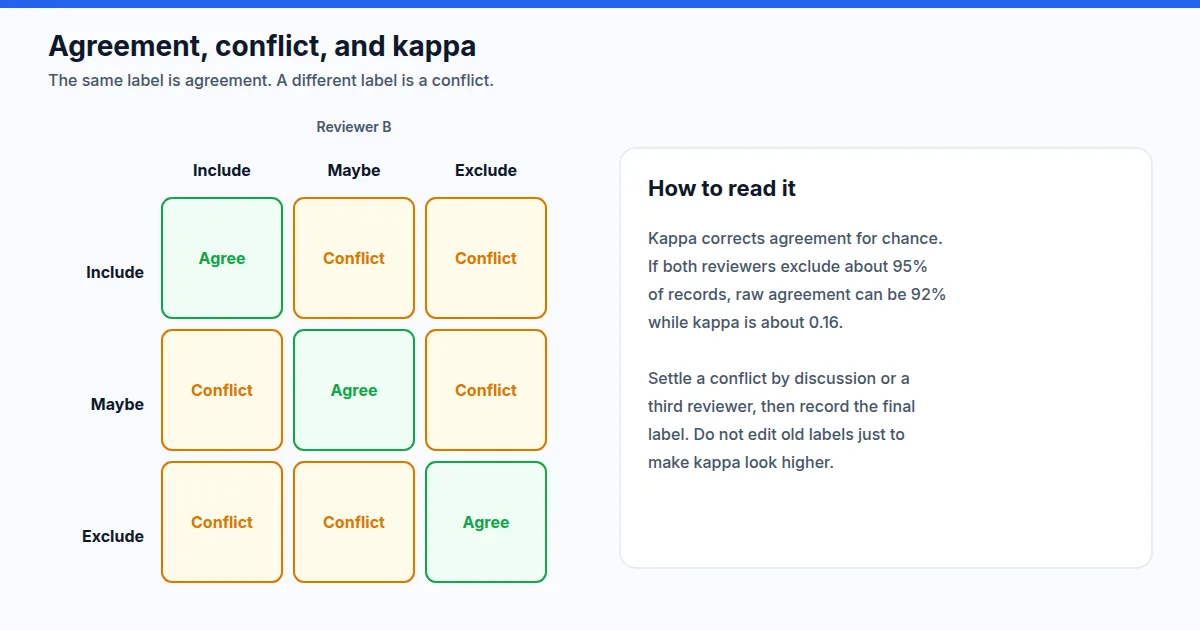
Dual Screening in Systematic Reviews: Conflicts and Kappa
Why systematic reviews use two independent screeners, what single screening misses, how to read Cohen's kappa, and how to resolve conflicts.
Dual screening means two people decide, independently, whether each record meets the review's eligibility criteria. Disagreements are resolved by discussion. Wh...
Read more →
Study Screener vs Rayyan: feature comparison for systematic review screening
A practical comparison of Rayyan and Study Screener for title/abstract screening aligned with PRISMA 2020 and Cochrane study-selection guidance: imports, blinding, AI paths, exports, and honest gaps.
Purpose. Help you decide whether Study Screener fits your title/abstract screening step—not to declare a universal “winner.” Rayyan is widely used for collabora...
Read more →